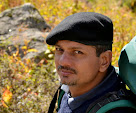
Powered with a few days of uphill walking and fresh mountain air, Doc and I looked ahead to a few more excursions. Unfortunately, time permitted only one — Deoria Taal. A small lake, situated about 2,400 metre from the sea level, Deoria is a mere two-and-half km ascent from a small village called Sari, about 10 km from GMVN guest house. Thus there was no hurry to leave our blankets. After a warm-water shower and a breakfast of eggs and paranthas (complete with butter cubes) at the local market, we slipped into the Xing for the day ahead.
The dusty lane which led us to Sari village offered us little scenic view. The sun was bright and it had become pretty warm when we parked our car. Help came even before we could stretch our shoulders. A young boy offered to play the guide to the Taal for Rs 200, lest we lose our way. We accepted the deal. In hindsight, though, it wasn’t a bargain; for it is difficult to lose your way from Sari to Deoria Taal. It is a small zigzag tract trailing which one reaches Deoria in less than an hour.
The ‘jungle’ route was shorn of any greenery and rarely a bird cooed to amuse us. The sun was getting warmer and our foreheads shone with beads for the first time during our entire trip. And then, suddenly, we ran into a shock of green. We were close to a plateau that was on the top of the hill. And it brought us into a cool green surroundings, offering mighty view of snowy Chaukhamba peaks. As we crossed two small hutment, selling chai-maggie and ciggies, a serene lake showing reflections of snowy peaks, made the picture complete.
The clean waters were so tempting that I was down to my undies in a flash, looked back at my guide for an approval and splashed as soon as he nodded. Woooooo.... the icy cold water was a real shocker. As I raised my head, shaking and screaming, I saw the guide too had taken off his clothing for the dip. Doc knew better and merely enjoyed the scenery and serenity from the fringes, smiling at my wet looks.
The sun was still bright but it was soothing on the skin now. A few hours passed without notice. Over a cup of sweet coffee, the hutment owner told us there is a trek route from Deoria Taal to Chopta, via thick rhododendron jungles. But one would require a guide. Yes, there was arrangement to stay overnight at the Taal and party. "Bahut log aate hain, (many people do that)," he said without any enthusiasm in his voice. Promising him to come back soon, we turned back.
We reached Rudraprayag via Gopeshwar in time for a late lunch. My lips had dried beyond immediate repair, thanks to the snowy winds they faced at Chandrashila, and eating a spicy lunch was torture. Doc offered lip balm, but it still hurt at every smile. I have always find downhill, homeward journeys depressing, and this time the bruised lips added to the woes.
A night spent at Dehra Doon, after some frantic drunken driving, and we were soon off to Delhi. Doc took over the wheels since I was getting snappy at fellow drivers, at smallest provocation.
I love Delhi which has been home for my entire existence thus far, yet compared to a parental hill, the city of growing shopping malls looks like a mighty hostel, devoid of family food, doting father and sibling sports.
Jan 16, 2007


Dec 28, 2006
Scaling Chandrashila Peak
 Driving from Ukhimath to Chopta was sheer pleasure (pardon the cliché). Stretches of mighty pines and bushy rhododendron reminded me of the picture postcards addressed Switzerland; the sun pierced through dense pines, as shown in many a Hindi song; and meadows offered tempting camp sites. If time were on our side, I would have pulled over, to spend a complete day there.
It was a two-hour journey, on freshly tarred road, that reached us Chopta. There used to be a guest house in Chopta a few years ago but after the area was declared a sanctuary — banning use of generators or electric lights — only a few tin-sheds remain, with basic night shelters and food for the visitors. A lot of locals visit the Tungnath temple during the 'season'. While the ascent is a mild trek for the trained foot soldier, taking about a little over one hour, Pepsi dudes find it a tough call. A couple of kilometres up ahead is Chandrashila, the training ground for budding mountaineers where GMVN (Garhwal mandal vikas nigam) organises a session every winter.
As Doc and I looked at the route before us, a friendly advice came from the dhaba-owner whom we had enquired about a guide to Chandrashila. “Ab toh guide nahi milega, sirji (too late for a guide now) aap bas German team ke nishan pakad lena ( A German team had gone there early in the morning; you can follow their footsteps on the snow to keep in direction.) On hindsight, as I write this piece, this was a sound advice. For, when there is snow and heights all around you in a huge semi-circle, it is not difficult to lose way. Losing way means going in circles, tiring your bones up and down… but reaching nowhere.
Packed with advice and adulation, Doctor and I began the pilgrim. Wi
 th age, experience and fitness on my side, I soon left Naren paces behind (sorry to rub it, Doc). But it goes to his credit that the old man proved to be no mean horse; steadily, almost like a tortoise, he pushed himself till Tungnath temple, whereafter it became snowy all around and he called it a day not due to lack of courage but for his soggy sports shoes. The kind soul even left a few tetrapacks of fruit juice for me behind, before turning his back (the juice-kit was taken care of by a pack of thickset langurs in my absence).
Before moving ahead from Tungnath temple, which was submerged in thick solid snow, I sat on my haunches to revive breath and survey the road ahead. In that 180-degree arc of snow-bound area, pray where to start? Cold weather biting my cheeks, I decided to look for the 'German footprints'.
Help came after walking alongside a roof (the dwelling was nearly fully under whites). I traced the ankle-deep fo
 otmarks on a virgin tract towards the right. Infact, there were two trails, which merged into a wider footpath higher. The problems began thereto. The footmarks worked fine as a guide, but they were slippery and unreliable for holding a new foot; one had to make his own path up at a painfully slow place (I rued why I ignored Deva’s request in Hrishikesh to take an ice-axe with me). My shoes-soles had worn out and their spikes barely worked. The way to move, therefore, was to first dig my leather heels hard into the snow, make a footrest of sorts, and then lead oneself upward.
Thanks to the foot trail, and some hard hitting, I reached Chandrashila in about one and hafl hours. I regained my breath, as soon as I looked around; the view swept away the fatigue. I was surrounded by smiling snowy peaks — all fair and lovely — in a 270 degree arc. For one brief hour, I just sat near the small Chandrashila temple, motionless. Meanwhile, the mind bubbled with ideas, stories, anecdotal phrases, and plans to bring more friends there... Only when the weather sent a few warning signals that I got up, grudgingly. My knees made an unfamiliar creaky sound, signaling the coming of age, and the hardships that the weathered joints had taken.
The downhill slide was rife with risks. The slippery snow and no hold-ons would ensure that if I slip once, I would be taken to some pit in the same direction. But moving slowly, I devised a way to come down without hurting my muscles. I would tilt 45 degree backward and jump in the desired direction to move. This would glide me down to a stretch as long as I could balance myself like a skiing enthusiast, and then when I were to stop I would dig my hand into snow to break pace. A few times, I did lost my direction and had to stab my left arm a few extra times with regret. But nevertheless in less than 15 minutes, I was at Tungnath temple, trying to rub my numb hands to life.
After that it was just a run-down – which includes a brief encounter with langurs who had taken care of the snacks left behind by the doc and a few painful landings on the slippery stones. Less than an hour later I was back to where the journey on foot had begun. Doc had a jealous look in his eyes when I expressed gratitude. Two warm cups of tea and we were back in the X-ing to scale back to Ukhimath.
"Go to the bazaar area first. We have to buy chicken, onions and garlic today. I will teach the bugger (a mild reference to the lazy GMVN bawarchi) how to cook a meal," Doc muttered minutes before we hit Ukhimath. I knew I would have a delicious dinner tonight....
(The last part of this sojourn, i.e., our visit to Deoria Taal and Dehra, appears next)
(The last part of this sojourn, i.e., our visit to Deoria Taal and Dehra, appears next)
Dec 12, 2006
Road to Ukhimath
Mountain roads remind me of school days. The times when every day or every hour brought about unexpected joys and unexpected sorrows – short-lived, all. Hill routes bring views that may last for a mile or a minute and you never know what the next sharp turn has in store for you: dizzy heights, devilish ditches or merely a painful round of steering-pulling… thus, the wheels move on. About six hour of such tortuous wheeling, Naren and I finally reached Ukhimath; in fact we nearly surpassed it and were forced to take a U-turn.
I must enlighten you here that a U-turn in Uttaranchal hills is no mean drill. One has to first find a wide stretch to exercise the turn and then slice the vehicle to its extreme left, greedily. This would be followed by moving back and forth several times to achieve a neat 180-degree round, watching out all the time that neither the backlights bump a rock nor the rear wheels slid off the road. One respite is lack of traffic, though the driver must watch for pahari kids who may get excited at the site of a horn-blowing vehicle at close contact.
The Kumaon Mandal guest house at Ukhimath, like most other KMVN units, is perched at a vantage place, offering liberal views of a deep valley, and a string of green hills. But the wind factor heightens the chill so we had little time for the verandah. The poker-face cook told us that he can dish out only gobhi for the dinner unless we bring home the chicken to roast. Valid argument, we surmised. Since I needed a PCO booth to tell my wife of my well being, we headed for the local market about less than a km on foot and did the needful. Frankly, throughout the trip, Doc proved a great help in fixing the lunch-dinner (thanks to his food-fixation); besides, he also carried a magician’s cap in his sack and produced tetra-packs of fruit juices with alarming frequency (alarming for the diabetic, that is).
The dinner at Ukhimath, despite Doc's manoeuvres, was not much to write home about, but the cold weather, hilly walks and rum were doing wonder to our appetites. We drank well, ate better and crashed with the TV screen on (yes, the tube was there even when most of the ‘interesting’ channels were missing).
On our worksheet the day next was Chopta-Tungnath-Chandrashila combo while the following 24 hours were booked for Deoria Taal. Since Ukhimath is kind of a midpoint for the two excursions, we decided we should stay for one more night at the lodge. Frankly, if one could fortify oneself from the icy winds, the Kumaon Mandal unit at Ukhimath is a poet’s muse. Too bad that neither Naren (sorry from dropping the title, doc, but it reminds me of Manmohan Singh) nor yours truly felt poetic at the end of a busy day. Hence, we missed the Muse and embraced the Bacchus.
(For the Chopta-Chandrashila climb, wait for the next posts, friends!)
I must enlighten you here that a U-turn in Uttaranchal hills is no mean drill. One has to first find a wide stretch to exercise the turn and then slice the vehicle to its extreme left, greedily. This would be followed by moving back and forth several times to achieve a neat 180-degree round, watching out all the time that neither the backlights bump a rock nor the rear wheels slid off the road. One respite is lack of traffic, though the driver must watch for pahari kids who may get excited at the site of a horn-blowing vehicle at close contact.
The Kumaon Mandal guest house at Ukhimath, like most other KMVN units, is perched at a vantage place, offering liberal views of a deep valley, and a string of green hills. But the wind factor heightens the chill so we had little time for the verandah. The poker-face cook told us that he can dish out only gobhi for the dinner unless we bring home the chicken to roast. Valid argument, we surmised. Since I needed a PCO booth to tell my wife of my well being, we headed for the local market about less than a km on foot and did the needful. Frankly, throughout the trip, Doc proved a great help in fixing the lunch-dinner (thanks to his food-fixation); besides, he also carried a magician’s cap in his sack and produced tetra-packs of fruit juices with alarming frequency (alarming for the diabetic, that is).
The dinner at Ukhimath, despite Doc's manoeuvres, was not much to write home about, but the cold weather, hilly walks and rum were doing wonder to our appetites. We drank well, ate better and crashed with the TV screen on (yes, the tube was there even when most of the ‘interesting’ channels were missing).
On our worksheet the day next was Chopta-Tungnath-Chandrashila combo while the following 24 hours were booked for Deoria Taal. Since Ukhimath is kind of a midpoint for the two excursions, we decided we should stay for one more night at the lodge. Frankly, if one could fortify oneself from the icy winds, the Kumaon Mandal unit at Ukhimath is a poet’s muse. Too bad that neither Naren (sorry from dropping the title, doc, but it reminds me of Manmohan Singh) nor yours truly felt poetic at the end of a busy day. Hence, we missed the Muse and embraced the Bacchus.
(For the Chopta-Chandrashila climb, wait for the next posts, friends!)
Dec 6, 2006
X-ing In Kedarnath
 July is a hot month in Delhi. And if your dreams are made of mountains, it can become unbearable in the night. I barely winked the night before I was scheduled to leave for the snow-laden Kedarnath. I tosssed and turned, checked out the clock several times and tried to keep my eyes closed. The wait was over when the clock finally struck 4 and Dr Naren (a medical practitioner and not a PhD scholar by degree) confirmed his arrival. I leapt out of bed and in no time positioned myself behind the wheels of a trusted X-ing for the pilgrim. Less than 14 hours later, with a brief stopover at Rishikesh to pick up a tent, Doc and I touched Gaurikund — a hot-water spring from where the way to Kedarnath shrine begins on foot.
Bad news came first. The pilgrim route, still under snow, had not yet been opene
 d (how could I not check this before?). We would not be allowed to go ahead, a grinning pahadi cousin told me. Only PWD workers working on the fallen electric poles and lines of communication had the access to the route. The hilly hamlet wore a deserted look, save for a few young men playing carrom on narrow streets who greeted us with surprise. After we checked into a neat double-room for Rs 250 for night, we resolved to try our luck with the policemen watching the post. Our persuasive skills and a Times of India Press card were put to test before the goalkeeper. It was the Press Card more than our sweet talk that melted the khaki. The Inspector in-charge told us that we shall be allowed only if we accompany the patrol team, which visits the pilgrim route everyday to survey the last point and hound any stray sadhu who may have escaped their watch.
 Doc and I raised a toast. Two small glasses full of dark rum clinked in
 the quiet of a darker night. Few men can have a sleepless night, after 14-hour journey and 160 ml of rum (though I must admit that in younger days I have defied worse conditions). Once the Spartan dinner reached our bellies, the two of us fell like a tree.
It was freezing cold when we got up, but after a brisk walk to the sulphur spring (called Gauri tapt kund), things brightened up. Nothing can be more refreshing than a morning walk to an adolescent river and even more soothing is to find warm waters to wash away your fatigue.
It is about 14 km of walk, mostly uphill, that takes you to the Hindu shrine. For us, it was a mild trek to tone up our ill-used limbs. And although we didn’t go all the way to the shrine, we enjoyed the stretch which woul
 d be otherwise busied with too many pilgrims, porters, pony-riders, polythenes muck and tea stalls. On the flip side, the patrol party was too quick to keep pace with. We had to request them at regular intervals to go slow so we could revive our breath. Thankfully, in due time, we were back for a late lunch. Fresh lauki ki sabzi, dahi and warm rotis tasted divine. The total bill didn’t cross 50 buck even when our bellies showed a devil’s appetite.
During the lunch itself, we decided there was little time to rest, for we must reach Ukhimath before night if we were to keep our date with Chandrashila peak the next day. Before one could say scoobydoobydoo… the X-ing was negotiating Himalayan bends once again, to reach KMVN tourist lodge for a cosier night.
(Our date with Chopta, Chandrashila and Deoria Taal will appear in the next post)
Nov 26, 2006
...In the Forest of the Night
Going To Jim Corbett National Park?
(an edited version of what I submitted to BritannicaIndia)
Death rules supreme in the woods. Thick cover of sal trees, unabated growth of lantana bushes, and dense long grass — nowhere does life sit as precariously as it does here. There are patches that even daylight cannot penetrate, where the vision is minimal and where one has to rely on instincts alone. One slip of toe, single faulty step, or one bad judgment can send you reeling into the jaws of death. Even predators can become the prey. But, is there no possibility for the man to watch these mysteries of wildlife unfold, from a self-inflicted periphery. Mercifully, there is…
Welcome to the wild stretches of Jim Corbett National Park, the first wildlife reserve of India, extending over an area of more than 500 sq km in the Himalayan foothills. Thanks to trained guides and State tourism department, you need not be too adventurous to stay in the middle of jungle — now strewn with lodges — and witness the wildlife in jeep/elephant safari. But must I disappoint you, it is as difficult to sight a tiger here as in a nearby town. Despite being a resident pahari, having seen boars, jackals, even a leopard at my very own village in Harda, in my 37 years of existence the closest I have come to a tiger is an angry grunt, 'fresh' paw marks, pee shots (fresh, of course) and nail scratches on the wood... once in a jeep, a friend pointed to a striped tail but till date I am not sure if it really belonged to a tiger :)(
Nonetheless, a brief stay at the park should remain a fond memory. For, to spot a leopard perched atop a tree or licking his paws; to watch a regiment of elephants frolicking at Dkhikala site; or to even hear a tiger growl late in the night, indeed make a gripping bedtime story for your grandchildren. First two months of the tourist season that begins in November are ideal for bird watching. While I could never spot a tiger in Corbett despite close proximity, I have been able to watch at length what amon bird-watcher as the tiger-with-wings — great Indian hornbill. Just to watch this super-bird loudly flap its wings is a sight to cherish. Infact, if one were to believe the experts or a guide, one can spot over 500 species of winged creatures here; prominent among them being greylag, barheaded goose, grepe, snipe, sandpiper, gull, hornbills, warblers, finches, and a series of wagtails (I have seen so many that I have lost count and desire to classify).
Timings Are Important: The onset of March thereto is best suited for animal viewing. Corbett Park is considered to have the highest density of Tiger populace in the country, approximately one every 10 sq km. Nonetheless, tiger is an elusive cat, and its sighting is rare for amateurs. One may come across alarm calls made by birds and monkeys, indicating the presence of a predator in the vicinity, but to spot this majestic animal remains an ambition for me. Even those groups who camp overnight near a waterhole on full moon nights, lament that the closest they came to a tiger was its growling voice in the dead of night.
Guides are an expert in building the suspense, by showing you a week-old pugmark and gesturinga sssshhhhh, telling you to "be patient and quiet" but all that is a well-rehearsed drill to earn their bread. Not every pugmark leads you home.
Elephant herds on the other hand are easier to spot if you have entered from Dhikala. Mind you, in a pachyderm family, calves are the most enjoyable to watch. But one should also not forget that elephants are more possessive of their young than a tiger. There have been many instances when they charge at the jeep and it is not a mock charge as those of tigers. A safe distance is always advisable.
Leopards in Corbett are well fed, thanks to a regular supply of the simian prey, but just as elusive as tigers. Other feline species found in the Park are jungle cats and caracal (again pretty elusive because of their size). Wild boars, jackals, spotted deer and hog deer are easy to be spotted though.
Survivors Will be Prosecuted: Reptiles basking in the swampy banks of the Ramganga are also a delight to watch. But more than cocodiles or gharials (gavialis gangeticus), large size geckos are easy to sight, espcially near the river. The Ramganga river flows through the entire length of the park and little forest streams and rivulets tumble through the ravines. The river is rich with mahaseer — a sporting fish prized by anglers, though angling inside the park is not permitted but allowed by several resorts on the periphery. One notice at Ghairal that warns against swimming in the Ramganga needs a mention here. It says: “Survivors will be prosecuted”.
Brave as a Tiger (Corbett's Profile)
A word about the early years of this park, and also Jim Corbett, the legendary hunter-turned-conservationist, would not be out of place here. It was in August 1936 that the British Government, on the advice of Jim Corbett, declared this foothill region of United Province (now Uttar Pradesh) as Hailey National Park, naming it after the UP Governor, Sir Malcolm Hailey. After Independence, in 1952, the Park was rechristened as Ramganga National Park, situated as it was on the banks of the river Ramganga, one of the major contributory of the Ganges. Five years later, the forest reserve was renamed yet again as Jim Corbett National Park.
Corbett, a middle-level officer of Scottish origin, had rid the Kumaon and Garhwal regions of man-eating tigers and leopards. Known as Carpet Sahib among local paharis, he became a folklore even during his lifetime. Brought up in the Kumaon administrative district, Corbett, the eighth child of a postmaster, gave up on academics early, proved his prowess at the gun at the age of eight. In his early days, hunted peafowl or boars for family kitchen. Gradually, he was drawn into big game. His splintered career included working as a storekeeper, contractor, as well as captain in World War I. But it was his way with the jungle that earned him recognition.
Stories of his bravery in prose and verse ran far and wide the UP hills. He was revered as a deity by most and considered a White Brahmin by all in the hills. During his last days in British India, Corbett transformed into a conservationist, hung up his boots, and worked for the betterment of Indian wildlife. A national park after his name was a befitting tribute to this hero.
The sleepy town of Ramnagar attached to this park is now home to a host of local tour operators, who earn an honest living by organizing quick safaris in the park. Cheap accommodation is therefore no problem for budget travelers. And for the luxury oriented, there are up-market cottages bording the park with most modern facilities.
(an edited version of what I submitted to BritannicaIndia)
Death rules supreme in the woods. Thick cover of sal trees, unabated growth of lantana bushes, and dense long grass — nowhere does life sit as precariously as it does here. There are patches that even daylight cannot penetrate, where the vision is minimal and where one has to rely on instincts alone. One slip of toe, single faulty step, or one bad judgment can send you reeling into the jaws of death. Even predators can become the prey. But, is there no possibility for the man to watch these mysteries of wildlife unfold, from a self-inflicted periphery. Mercifully, there is…
Welcome to the wild stretches of Jim Corbett National Park, the first wildlife reserve of India, extending over an area of more than 500 sq km in the Himalayan foothills. Thanks to trained guides and State tourism department, you need not be too adventurous to stay in the middle of jungle — now strewn with lodges — and witness the wildlife in jeep/elephant safari. But must I disappoint you, it is as difficult to sight a tiger here as in a nearby town. Despite being a resident pahari, having seen boars, jackals, even a leopard at my very own village in Harda, in my 37 years of existence the closest I have come to a tiger is an angry grunt, 'fresh' paw marks, pee shots (fresh, of course) and nail scratches on the wood... once in a jeep, a friend pointed to a striped tail but till date I am not sure if it really belonged to a tiger :)(
Nonetheless, a brief stay at the park should remain a fond memory. For, to spot a leopard perched atop a tree or licking his paws; to watch a regiment of elephants frolicking at Dkhikala site; or to even hear a tiger growl late in the night, indeed make a gripping bedtime story for your grandchildren. First two months of the tourist season that begins in November are ideal for bird watching. While I could never spot a tiger in Corbett despite close proximity, I have been able to watch at length what amon bird-watcher as the tiger-with-wings — great Indian hornbill. Just to watch this super-bird loudly flap its wings is a sight to cherish. Infact, if one were to believe the experts or a guide, one can spot over 500 species of winged creatures here; prominent among them being greylag, barheaded goose, grepe, snipe, sandpiper, gull, hornbills, warblers, finches, and a series of wagtails (I have seen so many that I have lost count and desire to classify).
Timings Are Important: The onset of March thereto is best suited for animal viewing. Corbett Park is considered to have the highest density of Tiger populace in the country, approximately one every 10 sq km. Nonetheless, tiger is an elusive cat, and its sighting is rare for amateurs. One may come across alarm calls made by birds and monkeys, indicating the presence of a predator in the vicinity, but to spot this majestic animal remains an ambition for me. Even those groups who camp overnight near a waterhole on full moon nights, lament that the closest they came to a tiger was its growling voice in the dead of night.
Guides are an expert in building the suspense, by showing you a week-old pugmark and gesturinga sssshhhhh, telling you to "be patient and quiet" but all that is a well-rehearsed drill to earn their bread. Not every pugmark leads you home.
Elephant herds on the other hand are easier to spot if you have entered from Dhikala. Mind you, in a pachyderm family, calves are the most enjoyable to watch. But one should also not forget that elephants are more possessive of their young than a tiger. There have been many instances when they charge at the jeep and it is not a mock charge as those of tigers. A safe distance is always advisable.
Leopards in Corbett are well fed, thanks to a regular supply of the simian prey, but just as elusive as tigers. Other feline species found in the Park are jungle cats and caracal (again pretty elusive because of their size). Wild boars, jackals, spotted deer and hog deer are easy to be spotted though.
Survivors Will be Prosecuted: Reptiles basking in the swampy banks of the Ramganga are also a delight to watch. But more than cocodiles or gharials (gavialis gangeticus), large size geckos are easy to sight, espcially near the river. The Ramganga river flows through the entire length of the park and little forest streams and rivulets tumble through the ravines. The river is rich with mahaseer — a sporting fish prized by anglers, though angling inside the park is not permitted but allowed by several resorts on the periphery. One notice at Ghairal that warns against swimming in the Ramganga needs a mention here. It says: “Survivors will be prosecuted”.
Brave as a Tiger (Corbett's Profile)
A word about the early years of this park, and also Jim Corbett, the legendary hunter-turned-conservationist, would not be out of place here. It was in August 1936 that the British Government, on the advice of Jim Corbett, declared this foothill region of United Province (now Uttar Pradesh) as Hailey National Park, naming it after the UP Governor, Sir Malcolm Hailey. After Independence, in 1952, the Park was rechristened as Ramganga National Park, situated as it was on the banks of the river Ramganga, one of the major contributory of the Ganges. Five years later, the forest reserve was renamed yet again as Jim Corbett National Park.
Corbett, a middle-level officer of Scottish origin, had rid the Kumaon and Garhwal regions of man-eating tigers and leopards. Known as Carpet Sahib among local paharis, he became a folklore even during his lifetime. Brought up in the Kumaon administrative district, Corbett, the eighth child of a postmaster, gave up on academics early, proved his prowess at the gun at the age of eight. In his early days, hunted peafowl or boars for family kitchen. Gradually, he was drawn into big game. His splintered career included working as a storekeeper, contractor, as well as captain in World War I. But it was his way with the jungle that earned him recognition.
Stories of his bravery in prose and verse ran far and wide the UP hills. He was revered as a deity by most and considered a White Brahmin by all in the hills. During his last days in British India, Corbett transformed into a conservationist, hung up his boots, and worked for the betterment of Indian wildlife. A national park after his name was a befitting tribute to this hero.
The sleepy town of Ramnagar attached to this park is now home to a host of local tour operators, who earn an honest living by organizing quick safaris in the park. Cheap accommodation is therefore no problem for budget travelers. And for the luxury oriented, there are up-market cottages bording the park with most modern facilities.
Subscribe to:
Posts (Atom)